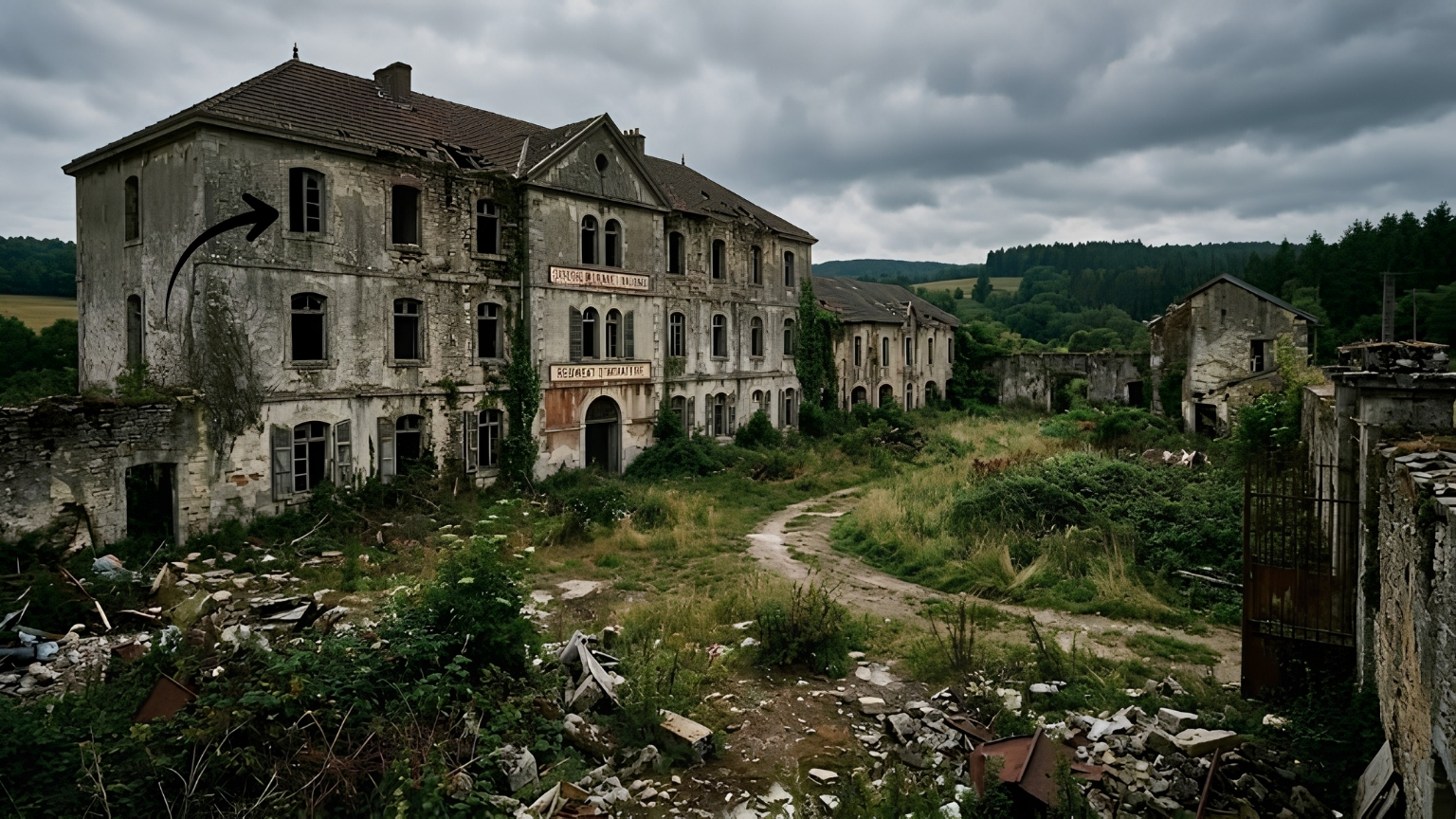
A former barracks can look like an answer to several local problems at once. Behind its walls may be room for housing, workshops, a school or a park. But the gate is not the only barrier. Before anyone can build, the site must be released, assessed, made safe and connected to the town around it. Each step can reveal a new obligation—and a new question about who will carry it.
France’s 2008 military restructuring set that process in motion across the country. One account of the reform describes 83 military-site closures, but that number should not be read as a count of barracks still empty today. Sites have followed different paths, and a nationwide total of those still awaiting reuse is not established by the evidence cited here. What is clear from later public audits is that difficult properties remained in the defence estate long after the initial wave of transfers.
A Closure Is Not a Handover
For a town, the departure of a regiment can feel immediate. Military families leave, activity around the site changes, and an enormous enclosed space suddenly seems available. In property terms, however, “empty” and “ready for local use” are different things.
A defence property must first be formally deemed unnecessary to military needs. The authorities then assemble a disposal file, including an assessment of the property.
The French Court of Accounts reported in its 2024 audit that military-property sales generally took three to four years from the decision that a site was no longer needed, compared with 16 to 18 months for other state property. Those figures describe the disposal process, not the additional time a town might need to redevelop the land afterward.
That distinction matters at the town-hall level. An architect can sketch a new neighbourhood, and residents can debate what belongs there, while the land is still beyond the municipality’s control. Even after a transfer, the drawing remains only a drawing until the condition of the buildings, the ground beneath them and the cost of adapting both are known.
The Burden Behind the Gate
Military sites were designed for military work, not ordinary civic life. A barracks may have accommodation blocks that need extensive renovation. A depot may require investigation of past fuel use. Land associated with ammunition can raise a different safety concern. None of these issues automatically rules out reuse, but each changes the order of work: investigate first, establish what must be done, then decide what the site can support.
The Court of Accounts has identified pollution, maintenance and security as costs that can weigh on a property before it is sold. It also found that the full costs of disposal were not sufficiently known or consistently accounted for. This makes an early promise of a quick conversion risky: the visible buildings are only part of what a future owner may inherit.
There is a second, less obvious difficulty. Barracks and forts were built to control access. Civilian neighbourhoods need the opposite: streets people can cross, entrances they can find, and services linked to the rest of town. A defence-ministry account of military-property conversion identifies this problem of opening enclosed sites and integrating them into the surrounding urban fabric as a central part of redevelopment.
The most attractive-looking proposal is not always the most workable one. A large former compound can offer plenty of space but demand new roads, utilities and years of building work. A historic structure may give a project its identity while limiting how freely it can be altered. The useful first question is therefore not simply, “What could fit here?” It is, “What can this town sustain here, once the whole site is taken into account?”
When a Transfer Creates Work
To help places hit hard by restructuring, a provision in the 2009 French finance law allowed eligible municipalities to acquire certain former defence properties for a symbolic euro. It was a way to make land available to communities with limited means. Yet the law also specified that the recipient took on the rights and obligations attached to the property as received. A low acquisition price could open a gate; it could not, by itself, repair a building or fund its next use.
Barcelonnette offers a particularly sharp example. After the army left the former Craplet military quarter, the town received a site of about 7.5 hectares with roughly 25,000 square metres of buildings. A regional audit published in 2019 found that converting it had placed a substantial burden on a municipality of fewer than 3,000 residents.
Parts of the site gained new uses, but whole buildings still had no settled purpose at the time of the audit, and the income generated did not cover all the running costs. Those are findings about the period examined, not a claim that the site remains in the same condition today.
The case is important because it complicates the word “reconversion.” A site need not be entirely abandoned for a project to be in trouble. One building may be occupied while another deteriorates. An ambitious facility may open yet require continuing municipal support. To someone passing the gate, progress is visible; to the people balancing the budget, so is the work still to come.
Reuse Needs the Right Scale
There are successful alternatives to leaving a former military enclosure shut. At Arras, the former citadel has been planned for a mixture of housing, leisure and economic activity, with an old powder store adapted for a data centre. It illustrates how a distinctive military building can gain a new function without erasing its character. It does not mean that every small town can reproduce the same result.
Demand and capacity differ from place to place. A town with a strong housing market may have options that a remote municipality does not. One with a large site but a small staff may need a broader partnership before it can manage surveys, planning, construction and long-term upkeep. National assistance can help: the state established contracts intended to support territories affected by military departures. The Court of Accounts nevertheless found that the aid arrangements had benefited territories unevenly and that their implementation fell short of the original ambition.
A more durable approach begins with the site’s limits rather than its most appealing artist’s impression. That means establishing its legal status, investigating hazards, identifying which buildings are worth keeping and testing whether proposed uses have likely occupants. It also means asking who will pay to maintain the site while decisions are made. These steps may slow an announcement, but they can prevent a municipality from accepting responsibilities larger than its means.
The challenge has not disappeared into history. In its 2024 audit, the Court of Accounts described a remaining stock of defence properties that were hard to convert—or, in some cases, difficult to sell at all. It called for a broader strategy that would consider options beyond straightforward sales and account more clearly for the costs attached to each property.
The question facing these towns is not whether an old barracks has potential. Many plainly do. It is whether ownership, safety, local demand and public resources can be brought together in the same project. Until they are, a site can sit in the middle of a community and still remain out of reach.
Table des matières — français
Partie | Contenu |
A Closure Is Not a Handover | Pourquoi le départ des militaires ne rend pas immédiatement le site disponible |
The Burden Behind the Gate | Pollution, sécurité, bâtiments et intégration au tissu urbain |
When a Transfer Creates Work | Ce que la cession peut transférer à une commune, avec l’exemple de Barcelonnette |
Reuse Needs the Right Scale | Les conditions d’une reconversion adaptée aux moyens et aux besoins locaux |