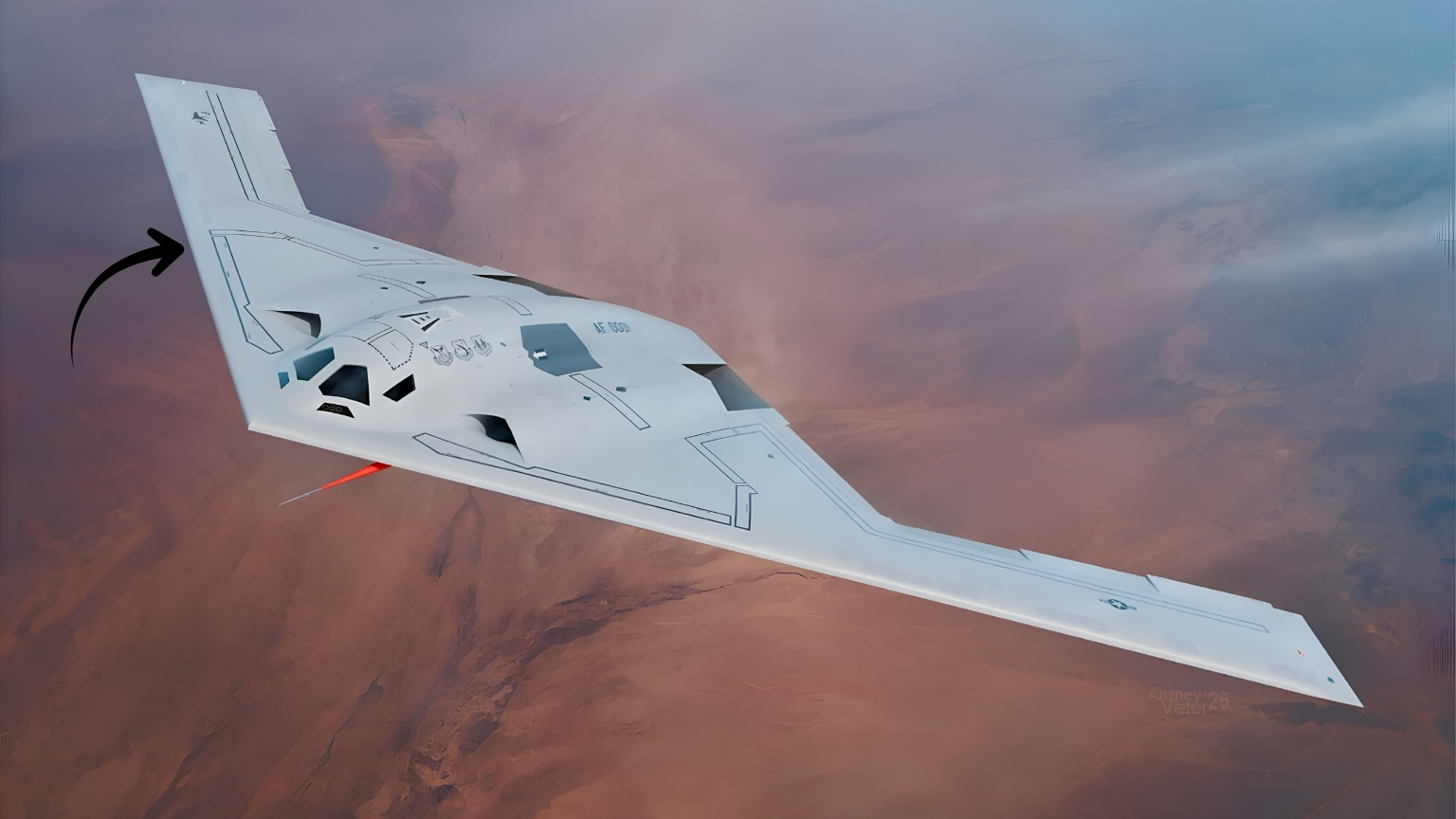
The B-21 Raider is built for a moment when an American bomber might have to cross heavily defended airspace and strike a target that other aircraft cannot reach. Its flying-wing shape and low-observable design draw attention. Yet the less visible question may prove just as important: how quickly can crews prepare it to fly again?
That question does not imply the B-21 has a known maintenance failure. Northrop Grumman says it designed the aircraft from the outset for frequent flying with minimal work between missions. The concern is more practical. A bomber’s value depends not only on what it can do in the air, but on how often it is ready to leave the ground.
The lesson from the B-2
The Raider’s predecessor, the B-2 Spirit, shows why maintenance deserves scrutiny. In a 1997 report, the U.S. Government Accountability Office found that repairing the B-2’s low-observable materials accounted for 39 percent of the maintenance labor recorded per flight hour during testing.
At Whiteman Air Force Base, total maintenance averaged 124 labor-hours per flight hour over a 12-month period ending in March 1997. Those are historical B-2 figures, not estimates for the B-21.
The trouble was not simply that technicians had to fix damaged surfaces. Some repairs required controlled temperature and humidity, followed by time for materials to cure.
The GAO reported that these demands complicated plans to deploy B-2s without shelters at forward locations. A bomber capable of flying a long distance could still depend on a carefully prepared place to land, recover and receive maintenance.
Decades of work have improved the B-2, and it would be misleading to assume the Raider will repeat its early problems. But the older aircraft established a principle the Air Force cannot ignore: stealth is not a feature installed once at the factory.
It has to be preserved through inspections, repairs and daily handling. A maintenance delay can become an operational limit long before anyone questions the aircraft’s flying performance.
Stealth adds another standard
Every military aircraft needs routine attention to its engines, electronics and structure. A stealth bomber has an additional requirement: the features that help reduce its detectability must remain within acceptable limits. That does not mean every mark on its surface automatically grounds it. It does mean maintainers need reliable ways to identify which damage matters and what work a particular mission requires.
Northrop Grumman says it has used lessons from earlier stealth aircraft to make the B-21’s low-observable processes easier to maintain. It also says digital tools and flight-test data are informing the training and sustainment systems intended for the fleet. Those are meaningful design choices, but claims made during development must ultimately be judged in squadron service, across many aircraft, crews and operating conditions.news.
Consider a Raider returning from a long mission. Ground crews may need to inspect its surface, address an equipment fault and prepare it for another sortie. If all three jobs fit within the available time, the aircraft remains useful. If a specialist, repair space or replacement component is unavailable, the next flight may slip. The aircraft’s range and survivability would not have changed; its availability would have.
A bomber needs a base
The Air Force’s preparations at Ellsworth Air Force Base in South Dakota make the importance of ground support unusually clear. In July 2026, the service said the base had accepted a Low Observable Restoration Facility and a Wash Rack and General Maintenance Hangar built for the B-21. The buildings are intended to let personnel inspect, clean and maintain radar-absorbent materials indoors, reducing downtime. Crews were still fitting out the facilities for use after their acceptance.
These buildings are evidence of planning, not proof that the Raider will be fragile. They show that preserving stealth has been treated as part of fielding the aircraft, rather than as a problem to solve later. The Air Force has also identified Tinker Air Force Base in Oklahoma for depot planning, while Ellsworth is designated as the first main operating base and the location of the formal training unit.
A well-equipped home base, however, answers only part of the question. In a crisis, commanders may want flexibility: aircraft operating at a demanding pace, maintenance crews working under pressure and missions continuing despite disruptions. The more a fleet depends on particular facilities, tools or expertise, the more important it becomes to know what can be done away from its principal bases. The B-2’s early deployment difficulties make that a question worth asking of the B-21, not a conclusion about how the new bomber will perform.
The problem of scale
The Air Force describes the B-21 as the backbone of a future bomber force alongside the B-52 and lists a planned inventory of at least 100 Raiders. In February 2026, it announced an agreement with Northrop Grumman to increase annual B-21 production capacity by 25 percent. Faster production could put more aircraft in service sooner. It would also make the quality of the maintenance system increasingly consequential.
Keeping a fleet ready requires more than teaching technicians how to work on one aircraft. Training, tools, spare parts, repair procedures and engineering support have to keep pace as aircraft arrive. If these elements mature together, a larger fleet can give commanders more usable options. If one lags, adding airframes may not produce a matching increase in aircraft available for missions.
Software adds a further dimension. The B-21 has an open-systems architecture intended to support future modernization, and Northrop Grumman says its digital development approach has shortened software certification time in the laboratory. That is encouraging, but updating an operational fleet also requires discipline: maintainers and operators must know which configuration each aircraft carries and how changes affect its support needs.
None of this makes maintenance an inevitable weakness. It explains why success in flight testing, important as it is, cannot settle the sustainment question by itself. Test crews work closely with engineers and have a limited number of aircraft to support. Routine service will expose the design to repeated inspections, ordinary wear and the demands of a much larger organization.
The real measure of readiness
Northrop Grumman’s ambition is clear: it says the B-21 was designed to be a “daily flyer” needing minimal maintenance between missions. The company has reported multiple test flights in a week as an early positive sign. It is fair to credit that progress while recognizing what it cannot yet establish about long-term fleet availability.
The decisive evidence will come from service over time. Can crews preserve the bomber’s low-observable characteristics without lengthy interruptions? Can they complete repairs with the people, equipment and facilities available? Can the Air Force sustain a useful flying schedule as the fleet grows? Those questions are more revealing than a single demonstration flight.
The Raider’s potential Achilles’ heel, then, is not a confirmed defect in its design. It is the possibility that the work required to keep an advanced stealth bomber ready could constrain how often, or from where, it can operate. If the B-21’s promised maintainability holds up, the Air Force will have addressed one of the B-2’s hardest lessons. If it does not, even an exceptionally capable bomber may spend too much of a crisis waiting on the ground.
Table des matières
Section | Sujet |
| The lesson from the B-2 | Ce que l’expérience du bombardier précédent révèle sur l’entretien |
| Stealth adds another standard | Pourquoi préserver la furtivité complique la remise en état |
| A bomber needs a base | Le rôle des installations et du soutien au sol |
| The problem of scale | Les défis liés à la croissance de la flotte |
| The real measure of readiness | Les résultats opérationnels qui permettront de juger le B-21 |